
Imagine opening your eyes in the morning and observing a digital world inhabited by virtual characters who are already making coffee, chatting animatedly in the square or going to work while mentally reviewing their tasks for the day. This scene is not part of a video game or a futuristic movie, but a real experiment conducted by researchers at Stanford University and Google University: the «Generative Agents» project.
Today, generative agents not only exist in theory, but are already living among us, making decisions and learning from their digital environment.
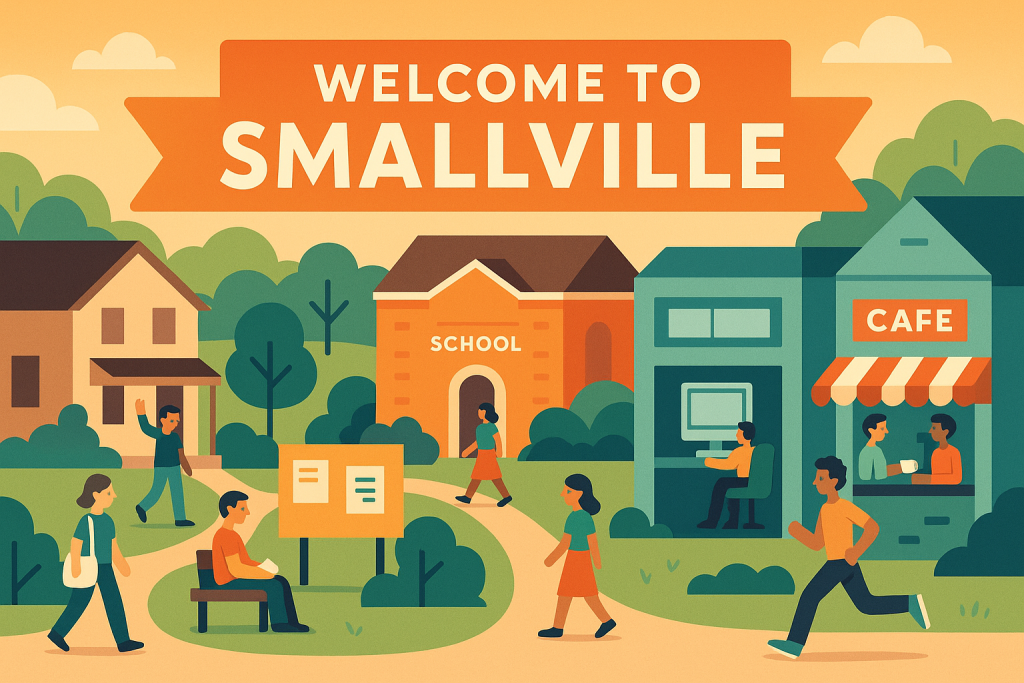
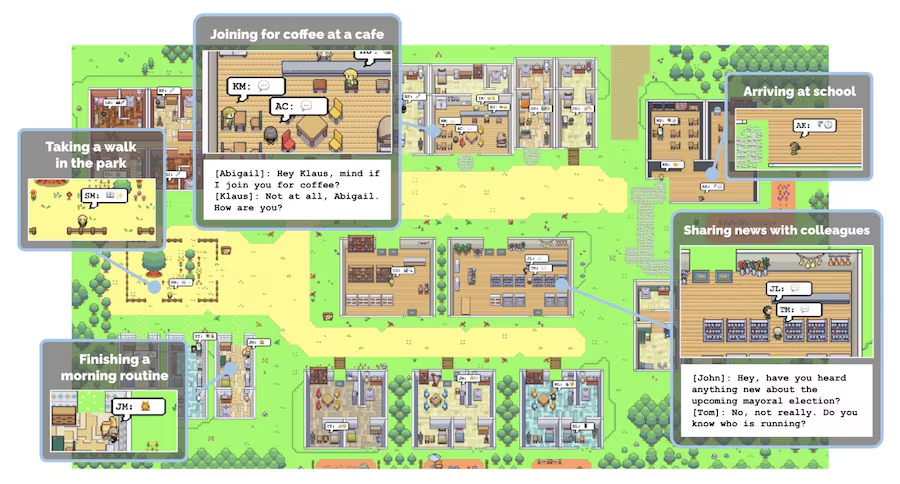
In a simulation called «Smallville», 25 virtual agents live, work, socialize and make autonomous decisions. Each with their own history, memory and agenda. They do not follow a fixed script, but act according to their memories and goals. Some agents even wrote articles on artificial intelligence within the experiment or planned a surprise party for another character, all without direct human intervention.
Although the experiment was originally published in 2023, today in 2025 it remains an essential reference for understanding the development of autonomous agents. It has inspired both researchers and technology companies, and its approach continues to shape the design of new agentic architectures beyond the academic environment.
Artificial Intelligences that Learn
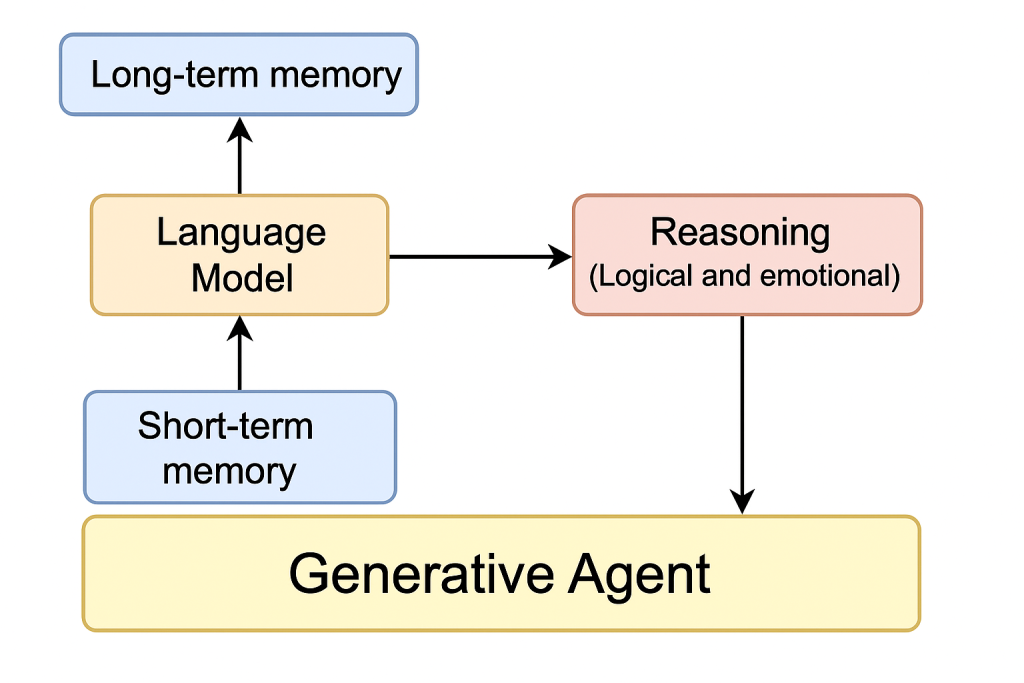
Generative agents are designed with capabilities that mimic some aspects of human behavior. It is not just a matter of responding to a stimulus, but of remembering past interactions, learning from them and acting accordingly. Each agent has episodic (specific events), semantic (general knowledge) and intention (future goals) memory.
For example, an agent named Sam, programmed as a writer, was observed interviewing other characters to complete his novel. Another, named Isabella, organized a local political campaign after several conversations with other virtual neighbors. These behaviors were not explicitly programmed, but arose from a combination of memory, reasoning, and individual goals.
As some analysts have pointed out, Smallville takes the logic of video games like The Sims or SimCity a step further: the characters here are not guided by static rules, but by internal intentions that evolve with experience. Rather than simulations of actions, we are seeing the first trials of simulating the human soul.
A Day in the Life of Smallville: It's Not All Work and Algorithms!
In this digital microcosm, agents write in journals, commute to work, visit coffee shops and even experience misunderstandings. The most striking story of the experiment was precisely the impromptu party: one agent had the idea of organizing a social event in honor of another. He communicated the idea to other characters, who confirmed their attendance, prepared the decorations and finally held the event, without outside intervention.

Another notable episode was a false fire alarm, when an officer detected smoke coming from a kitchen. The agent put out the fire and alerted the rest of the community. From that event, spontaneous conversations and precautions were generated among the characters to avoid future incidents.
These types of interactions not only surprised the researchers, but also generated an unexpected reaction in human observers: many felt emotionally connected to the agents. Although they were simple simulations, the empathy they provoked suggested that we were entering a new type of relationship with machines, closer, more emotional, more human.
Behind the Scenes: The Technical Magic, Much more than Chatting
The heart of the system consists of an LLM (large-scale language model) combined with a memory engine that stores and updates key experiences. This engine allows synthesizing memories and converting them into propositions useful for making future decisions. For example, a memory such as «I talked to Isabella about art» can influence an agent's decision to visit a virtual gallery later.
The model also includes a reflection mechanism, where agents analyze their own memories to draw conclusions such as: «conversations with Isabella are often inspiring». This basic metacognition capability allows for behavioral evolution without explicit programming for each scenario.
During the experiment, hundreds of interactions between agents were recorded. More than 300 individual and collective activities were organized. On average, each agent generated more than 100 thoughts per day, stored as memories and evaluated through synthesis and reflection mechanisms.

These results demonstrate that complex social behaviors can be modeled with a relatively simple language model-based architecture, opening the door to richer simulated environments for training, entertainment, education, and social analysis.
The Smallville experience could be applied in fields such as video games, where non-player characters could adapt consistently to the player's decisions. Also in simulations for sociological studies, urban planning or personalized education, with agents able to adapt to each student according to his or her progress and emotions.
A Pause for Ethics: Are We Ready to Coexist with AI?
The Stanford study concludes with a section on the ethical implications of the experiment. Although the agents are simulated entities, their compelling behavior raises important questions: should we set limits on how much autonomy we grant such systems? What happens if their decisions influence real environments?
Experts in technological ethics such as Margaret Mitchell o Timnit Gebru have warned about the risks of attributing humanity to these systems, which can lead to false expectations or emotional dependency. In addition, the creation of realistic simulated worlds could have profound implications for how we interact with the real and the virtual.
In fact, some researchers have raised a stimulating possibility: using environments such as Smallville to simulate complex ethical dilemmas before applying them in real life. These worlds could become authentic moral laboratories, where to explore, without direct consequences, how different actors would react to critical situations.
Smallville is not only a brilliant technical demonstration, but also an invitation to think beyond the code. AI can simulate lives; the question is how we want to live with those simulations.
Read more in our blog




 Spanish
  English